Road safety is a public health crisis
Part 2: To manage a public health crisis, we need a public health intervention. Vision Zero can't reduce deaths without Safe Systems.

Every year, 40,000+ people are killed on U.S. roads, and millions more are seriously injured—making traffic violence one of the leading causes of death for Americans under 50. New Mexico has the highest pedestrian death rate in the nation, with residents dying at a rate of nearly five per 100,000 in 2023, according to a report from Source NM.
In Part 1 of this series, I wrote about how New Mexico cities adopted Vision Zero, which aims to eliminate all deaths and serious injuries from car crashes, but failed to implement the policy and infrastructure changes needed to achieve that goal. Albuquerque, Santa Fe, and Los Alamos all committed themselves to the objective of zero traffic fatalities, yet road deaths and injuries remain stubbornly high—in some cases worse than before.
Achieving these laudable goals requires more than mere proclamations. Here, I want to explore the policy approaches that communities as diverse as Hoboken, Milwaukee, Austin, Mexico City, and entire countries like Sweden (the birthplace of Vision Zero) have implemented to dramatically reduce their traffic-related fatalities.
In short, they take Vision Zero seriously by adopting a public health approach to road safety.
Vision Zero is a goal, not a method. When communities get serious about implementing it, they turn to the Safe System approach: a public health–based framework that assumes people will make mistakes and designs roads so those mistakes are not fatal. Instead of relying on individuals to behave perfectly, Safe System approaches focus on managing speed, energy, and conflict through the built environment.
Most U.S. cities—including ours—never make that shift. We pass resolutions, hire consultants, hold meetings where residents vent fear and frustration, and call it a day. We rarely get to the part that matters: physically changing streets, land-use rules, and design standards to make severe crashes unlikely in the first place.
This piece explains what the Safe System approach actually requires—and why it works.
Vision Zero vs the ‘Three Es’
Vision Zero is a commitment to an ethical standard: zero traffic fatalities and severe injuries. The Safe System approach is the method for reaching that goal.
Both require dropping the traditional American approach to traffic safety: the venerable “Three Es”—engineering, education, and enforcement. The 2-minute video below explains the framework.
The Three Es approach, in practice, places the principal responsibility for safety on individuals: drive defensively and follow the rules, and you will be safe. Said this way, it seems obvious enough. Virtually everyone (myself included) supports driving safely and attentively. But mistakes, crashes, and deaths continue to occur, so it’s worth asking how effective the Three Es really are at achieving acceptable levels of road safety.
Or … are they attempting to optimize for other goals?
Consider what happens under the Three E framework when someone does get hurt: the municipality, the engineering firm that designed the road, the elected officials, and the police largely evade any responsibility for the resulting death and damage. In effect, they all get to say, “Hey, we did our part, we followed the standards, the rest is up to you guys.” It’s a way to check a box and move along.
One factor lurking beneath this hands-off approach is municipalities’ fear of lawsuits. As traffic engineer (and professor of engineering) Wes Marshall notes in his book Killed by a Traffic Engineer, “traffic engineers know that the three Es aren’t going to solve the problem, but traffic engineers also need it to look like we are doing something about the problem…this usually means road safety education campaigns” (p. 37).
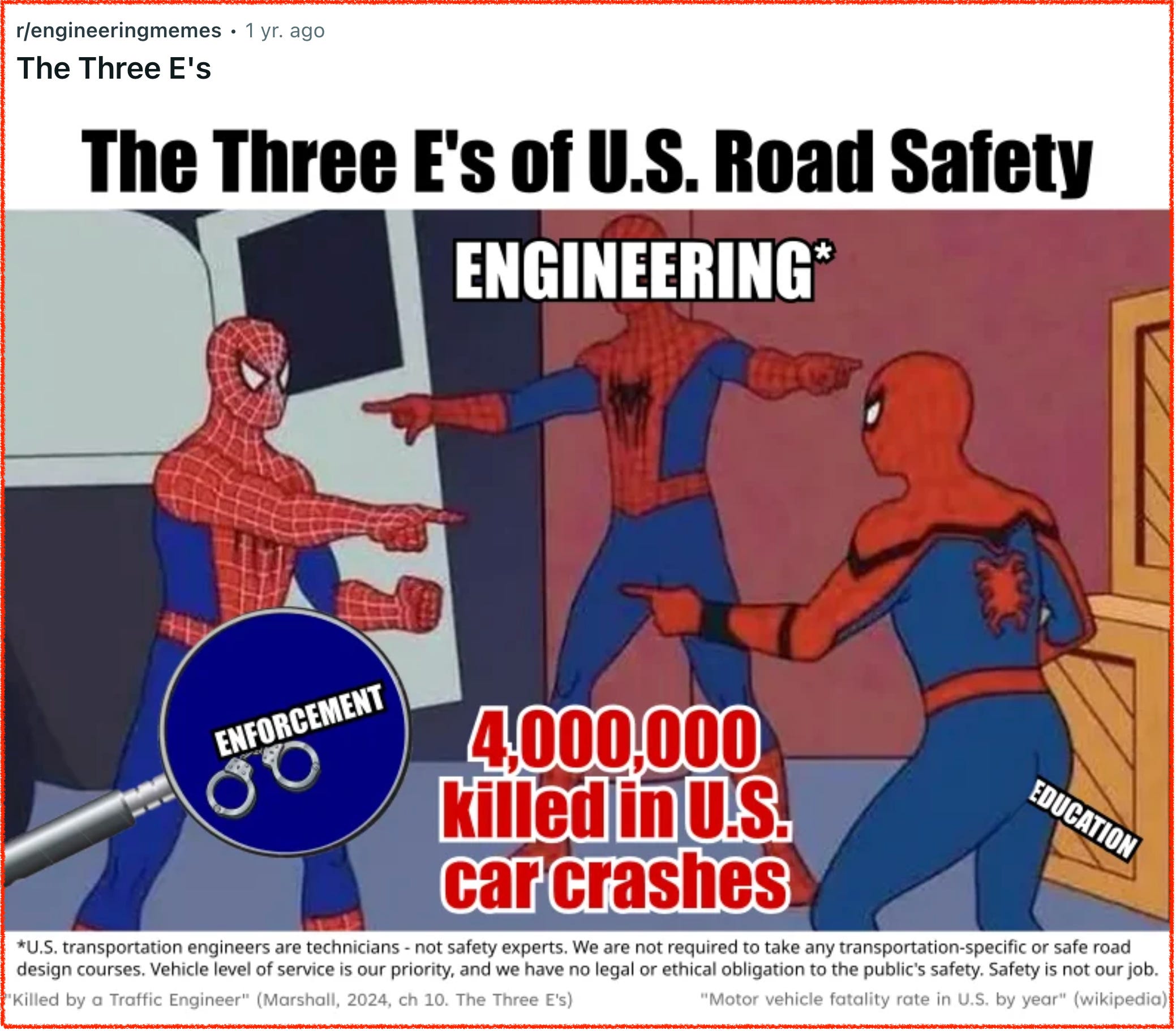
The Safe System approach, in contrast, is outcome-oriented, not cover-your-ass oriented. It recognizes that humans make mistakes. Drivers will speed. A parent will glance at a text from her child. A pedestrian’s peripheral vision won’t catch a turning car. Cyclists will swerve around debris. The purpose of a safe system is to absorb these predictable events so that no one gets killed or seriously injured when they occur.
A truly safe system aims to minimize devastating crashes rather than all crashes. Better a fenderbender at low speed in a roundabout than a fatal t-bone at an intersection.
The problem is that communities are declaring a commitment to Vision Zero without fully understanding what it means or implementing the safe systems needed to achieve those goals. It’s like declaring “zero plane crashes” while relying on individual pilots alone to be personally mistake-proof—no air traffic control, no airplane engineering, no radar, no failsafes; just vibes and a prayer.
‘Personal responsibility’ isn’t a policy
After every tragedy on our roads, officials reach for a familiar script: “Drivers need to slow down! Pedestrians need to wear bright clothes! Cyclists need to pay attention! Safety is a shared responsibility!”
Of course, it is true to the point of banality that if everyone followed the rules unfailingly, we’d see far fewer crashes. But it turns out that simply chanting “drive better, you idiots!” doesn’t change outcomes. Officials reach for this language because it converts a collective failure into an individual one. It’s politically safer to blame road users. It’s politically and legally riskier to redesign roads.
Implementing policy and infrastructure changes is hard, but it saves money and lives in the end. It’s what serious countries and communities do. Public health experts have long known that individual behavior never occurs in a vacuum. Health outcomes are shaped by multiple interacting levels of influence, and interventions that focus narrowly on individual behavior are almost always the least effective.
For example:
We didn’t eliminate smallpox by telling people to “wash their hands better.” We vaccinated at scale.
We don’t ask tenants to personally verify whether their apartment wiring will catch fire. We enforce building and electrical codes.
We don’t suggest people test their own drinking water for cholera or lead. We build centralized treatment systems and regulate them.
We don’t merely tell Lab workers to “be careful around radioactive materials.” We require training, checklists, redundancies, and failsafe systems.
We design the environment so safety is the default, not a daily test of universal individual obedience to rules.
Let’s talk pyramids
Public health science has created a pyramid-shaped framework for this approach—it should be familiar to anyone who has worked with OSHA’s “hierarchy of controls,” which was developed to protect workers from hazards on the job. Just as those responsible for (say) nuclear safety do not cross their fingers and hope everyone follows the rules, neither should traffic engineers.
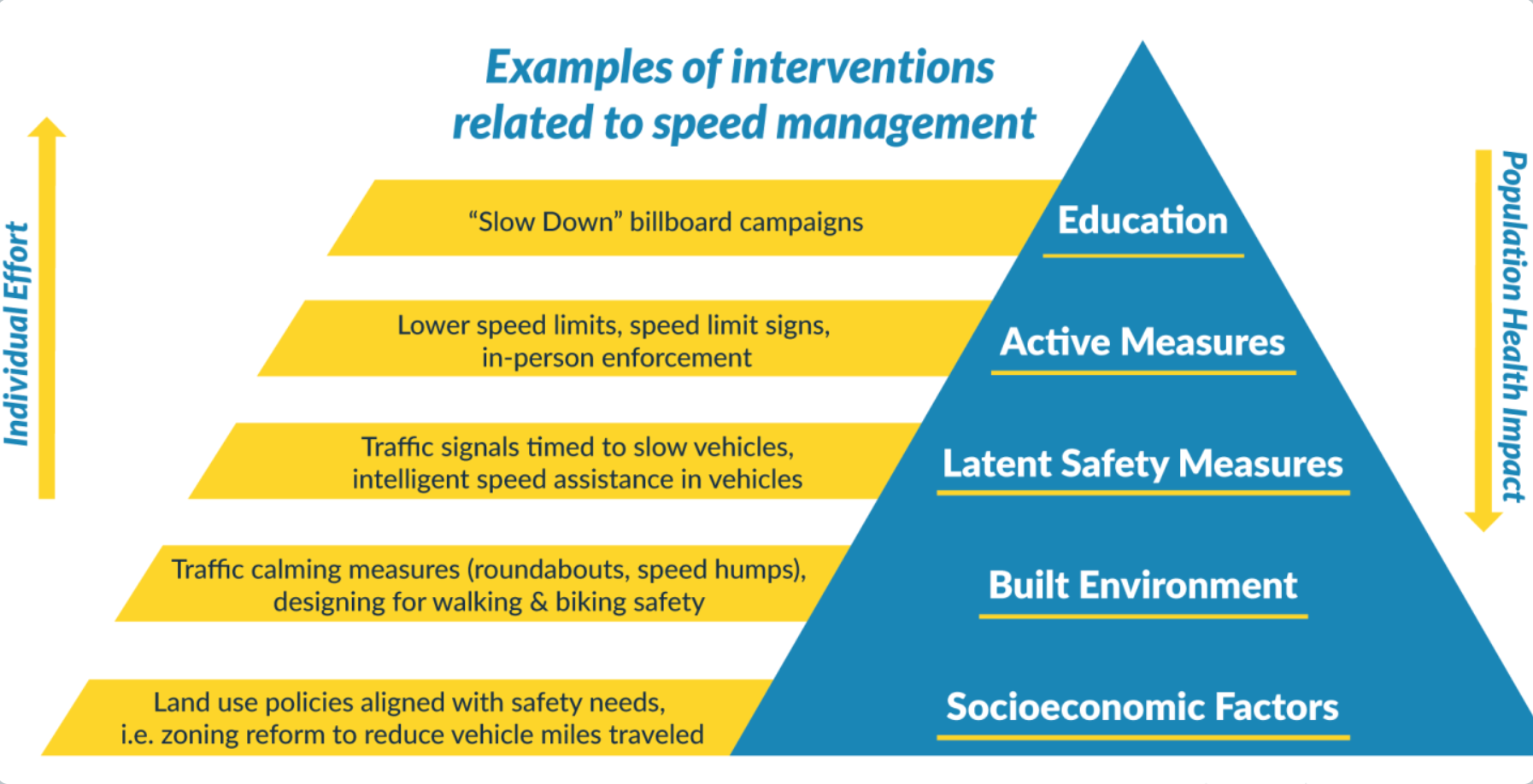
The Safe System pyramid you see above is adapted from the Health Impact Pyramid. Interventions are sorted by effort and payoff. Strategies at the top—education campaigns and awareness billboards—yield the weakest results. They assume a dangerous system can become safe through exhortation.
These campaigns are easy to launch and easy to praise, but they fall apart the moment attention lapses. Your boss writes a letter to the editor saying “everyone who gets behind the wheel must also take personal responsibility for safety,” and maybe you feel chastened for a few days. But whatever pressures caused you to speed to begin with soon reassert themselves, and you’re right back to your old habits.
The arrow on the left shows that these interventions require maximum individual effort—meaning, nothing systemic or politically difficult. The arrow on the right shows how population health impact increases as the individual effort required decreases. The more effort individual users of the system must put in to keep everyone in the system safe, the less effective the system becomes.
Design produces the behavior. Enforcement tries to manage it.
Moving down the pyramid toward the sturdy base shows what actually works. Active measures include putting more cops on the road and lowering the speed limit. Latent measures are more effective: Signal timing, giving pedestrians a head start at intersections, and intelligent speed assistance are tools that save lives without requiring constant vigilance.
The Safe System approach focuses on redesigning our built environment to reduce speed. Despite persistent myths to the contrary, the evidence is clear: wider lanes are more dangerous. Long sightlines, tree removal, and forgiving shoulders all invite fast driving regardless of the posted limit.1
Road diets, lane narrowing, roundabouts, and protected bike infrastructure are also in the “built environment” category. These redesigns annoy speed-brained motorists because they slow traffic down, i.e., they work. They don’t beg drivers to pretty-please make better choices; they force slower driving, making dangerous behavior harder to sustain.
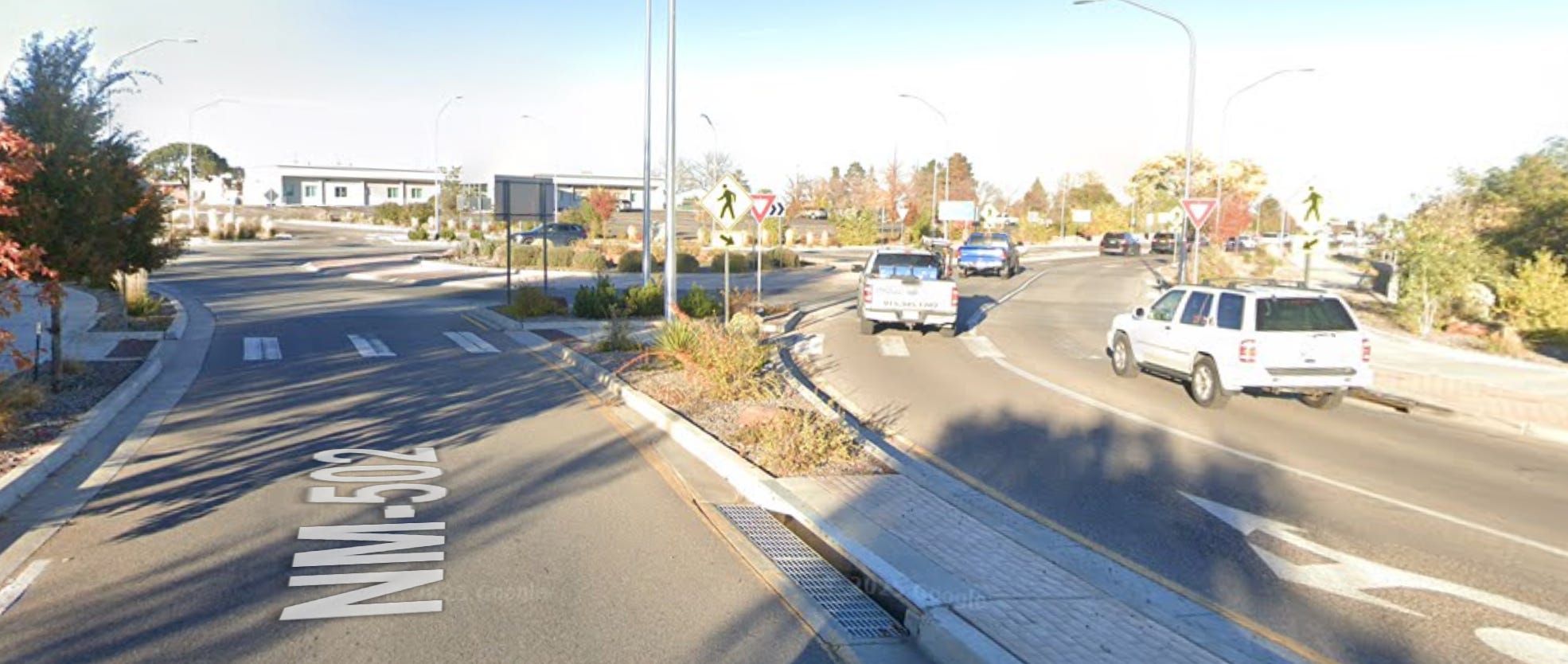
Design-based measures address something that most road users know intuitively: every road has a “felt speed,” a speed you’d drive even if there were no signs, a speed that feels right. It’s this feeling that determines how fast people drive—not the posted signs, and certainly not the cop car hiding in the bushes. Design and felt speed are interesting enough for their own post, so I’ll save the details for another day. The important thing to know for now is that when people believe that more law enforcement will solve the problem, they miss the fact that enforcement reacts to a behavior, while design produces the behavior to begin with.
We know that the way out of our road-safety crisis is through system design. That’s what works in public health. What doesn’t work is relying on constant vigilance from individuals or heavy-handed enforcement. Omnipresent surveillance and policing are prohibitively expensive and disturbingly Orwellian. Signage and constant, hectoring “education campaigns” eventually fade into an ever-noisier background.2 But physical road design is literally everywhere. It never fades into the background.
This explains why communities from Hoboken to Sweden have succeeded while we struggle. They changed the roads while we changed the signs.
Please see this discussion between two engineers who agree that what engineers are taught, when it comes to road design, is actually killing people.
To hear for yourself what it sounds like when the traffic safety division director for the New Mexico Department of Transportation defends the Three Es (by name) and doesn’t even mention the Safe System approach, listen to this interview.
I’m late to this article, but I have to chime in to say: amen.
I worked entirely on road safety during my six years at USDOT, alongside incredibly dedicated people who are genuinely trying to advance a public-health, Safe System approach to preventing fatalities and serious injuries on our roadways.
And yet, I can’t tell you how many times I’ve seen people give trainings on this topic who clearly don’t “get it.” Often, they don’t seem to realize how narrowly they’re focusing on individual behavior or that doing so is fundamentally at odds with what the Safe System Approach is actually about.
I am hopeful that things are starting to shift, and that more people are coming to recognize that these deaths and serious injuries are both preventable and unacceptable—and that the solution is not simply more education, enforcement, or paid media telling individuals to behave better, but systemic change by design.
Love love love this article. So much. Thanks for this. Also if helpful, there’s evidence of fewer crashes and deaths after the bus lanes were installed on Central Ave. I was going to mention it in my TEDx but I figured it was maybe too soon because people were still angry about getting used to the new bus lanes! But the fatality decrease was clear.