
The meeting stretched until midnight. By the end, the chamber was nearly empty—supporters had trickled out, exhausted and furious, after watching proposed zoning changes die one by one on 5-4 votes. The Albuquerque City Council had just rejected amendments that would have allowed townhomes, duplexes, small grocery stores, and other basic forms of human habitation in single-family neighborhoods. The changes had been drafted and recommended by the city’s own planning staff.
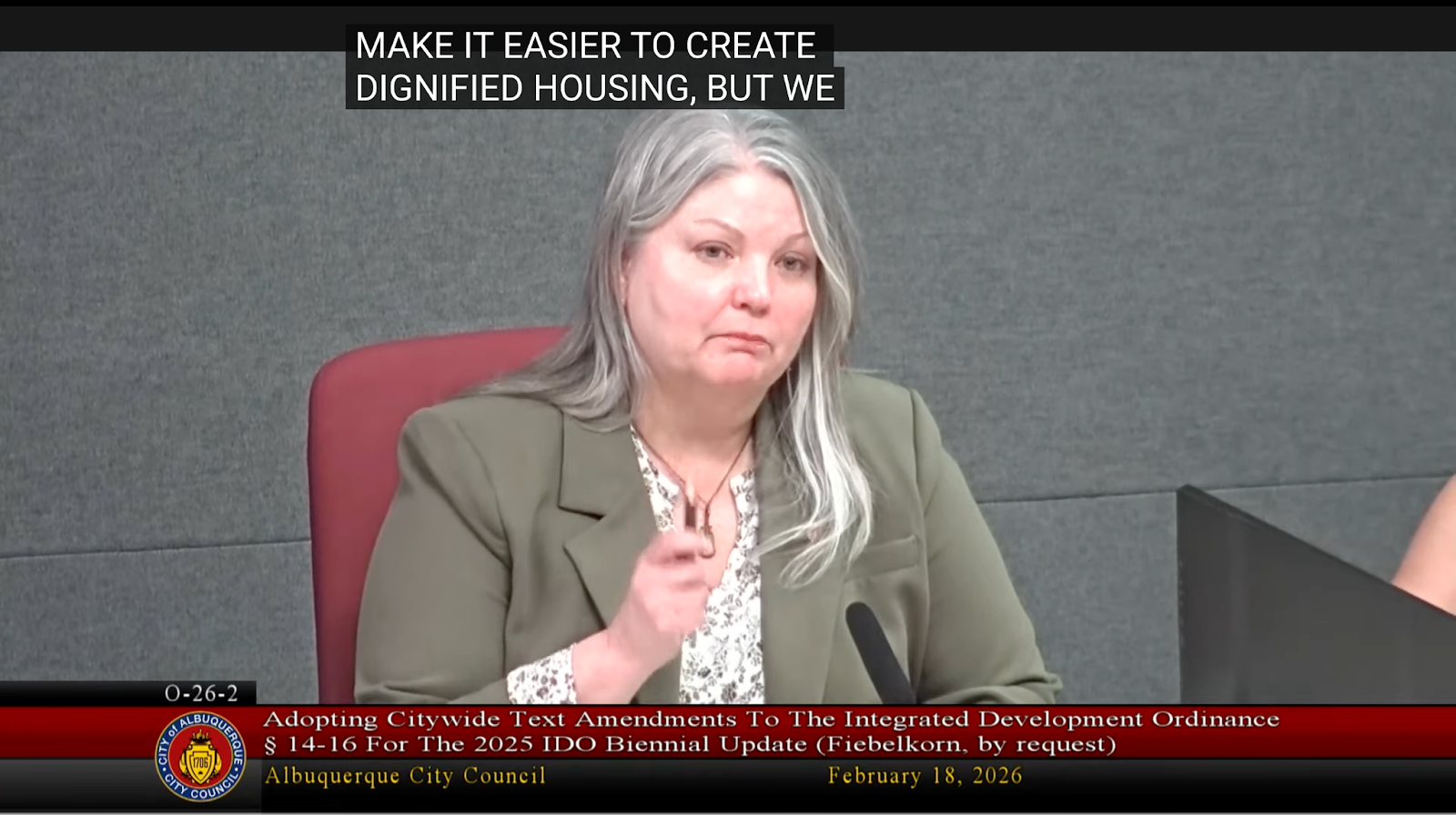
“In the end, we didn’t make it easier to create dignified housing,” said sponsor Councilor Tammy Fiebelkorn at the meeting’s close, “but we did make it easier to put in a fence.”
We heard a lot about “local control” this legislative session in the context of fighting bills that would allow more housing. What happened at the Albuquerque City Council is what “local control” means in practice.
At the Feb. 18 Albuquerque City Council meeting—one night before the New Mexico Legislature ended its session without passing any meaningful state-level zoning reform—one local elected body neatly demonstrated the local power dynamics that the proposed state-level reforms sought to overcome. With notable exceptions like Councilor Fiebelkorn, local elected officials are captured by powerful, entrenched homeowner interest groups that oppose zoning reform. Fiebelkorn is an exception that proves the rule.
For the entire 30-day session, in committee rooms throughout the Capitol, bills that would have legalized more kinds of homes across the state were killed with a consistent refrain: Don’t let the state impose a “one-size-fits-all” approach to land use. Local governments know their communities. What works for Albuquerque might not work for Ruidoso.
The loudest voice making the “local control is good” argument was the New Mexico Municipal League, which spent the session opposing Senate Bill 131 and House Bill 17—legislation that would have allowed duplexes, accessory dwelling units, small apartment buildings, and mixed-use development in areas that already have streets and pipes running to them. They also opposed House Bill 110, a mild bill that only asked cities to track their own permitting processes: “This is a textbook example of preemption legislation,” said Municipal League lobbyist Jacob Rowberry, in testimony against the data transparency bill. “These cities already track housing data and are willing to share it. It’s just not in the burdensome one-size-fits-all format called for in the bill.” Leave it to the cities, he said; left to their own devices, cities will do the right thing.
Then Albuquerque had its shot.
At the Albuquerque meeting, City Councilors Renée Grout, Dan Champine, Dan Lewis, Brook Bassan, and Council President Klarissa Peña voted against amendments that would have legalized naturally affordable housing, such as ADUs and duplexes. Councilors Fiebelkorn, Stephanie Telles, Nichole Rogers, and Joaquín Baca voted in favor of the affordability amendments.
Five elected officials decided that duplexes are too dangerous for Albuquerque’s neighborhoods, despite what city planners said, despite the clear evidence provided by the housing shortage data, and despite the passionate testimony provided by a room full of younger residents begging the Council majority to reconsider.
One size fits all
It’s worth rewinding to that “one-size-fits-all” phrase the Municipal League frequently uses to attack zoning reform. The phrase describes something real, just not the point they intended.
The true one-size-fits-all system is the one we already have: one detached single-family house per lot, replicated across thousands of parcels, neighborhood after neighborhood, city after city, regardless of what households actually need or can afford. Status quo defenders may like to pretend that uniformity arrived naturally, through organic choice. It did not. It was mandated from the top down, written into laws we call “zoning codes.”
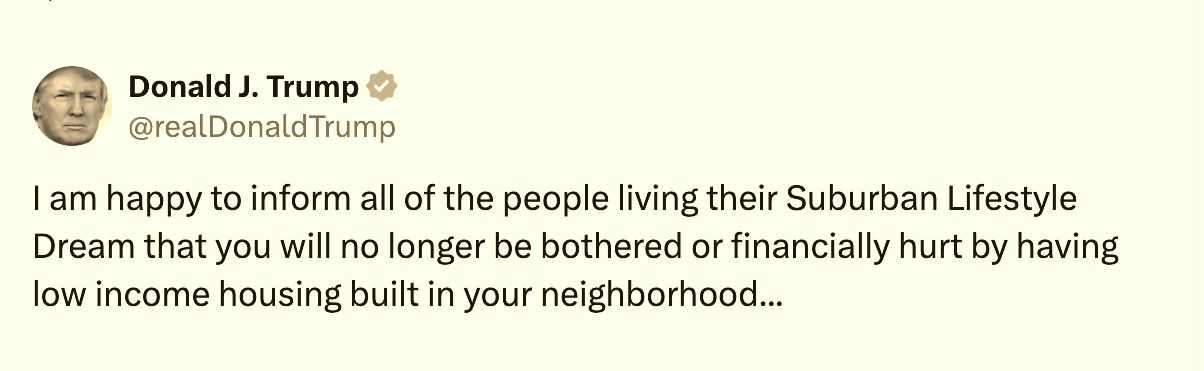
State reform, had the legislature accepted it, wouldn’t have imposed a new model. The reform bills were pushing for more flexibility, more options, more sizes—duplexes, casitas, incremental infill—at more price points. Calling that “top-down preemption” gets it completely backwards. The legislation would have removed a top-down mandate. The rigidity wouldn’t have come from the state. Rigidity already exists: it’s in local codes that lock neighborhoods into a single form and call that “neighborhood character,” to be protected at all costs.
The Legislature tabled the reform bills. The politics of the status quo reached their tentacles beyond local elected officials, slithering into the Roundhouse and wrapping around the necks of state senators and representatives. The consequences won’t be abstract: young New Mexicans will keep leaving, homelessness will keep rising, and housing will stay out of reach for the people the state says it wants to serve. Local control, preserved. Local affordability, sacrificed.
What the Muni League never did, in any of its testimony, was argue that current zoning is working. It never claimed rents are affordable, or that the housing stock matches what New Mexico households actually need, or that local governments have a plan to fix any of this. Their argument was strictly procedural—a defense of jurisdictional turf, not a housing policy. Defend the status quo loudly enough, and you never have to defend it on its merits.
There’s a reason for that, and it has everything to do with power.
Own the land, own the politicians
Land is a big deal, as they say. Land is power, which is why humans have fought over it from the beginning. Most wars are over land. Zoning is the tiniest, most constant form of that war. Land use (regulated in the United States primarily through local zoning) is fundamentally about who controls land and how that power is maintained. When housing scarcity inflates property values, homeowners acquire both wealth and veto authority—and the system slowly reorients itself around their preferences. Defending “local control” under those conditions becomes a mechanism for locking in advantage, without ever having to argue that the outcome is good or just.
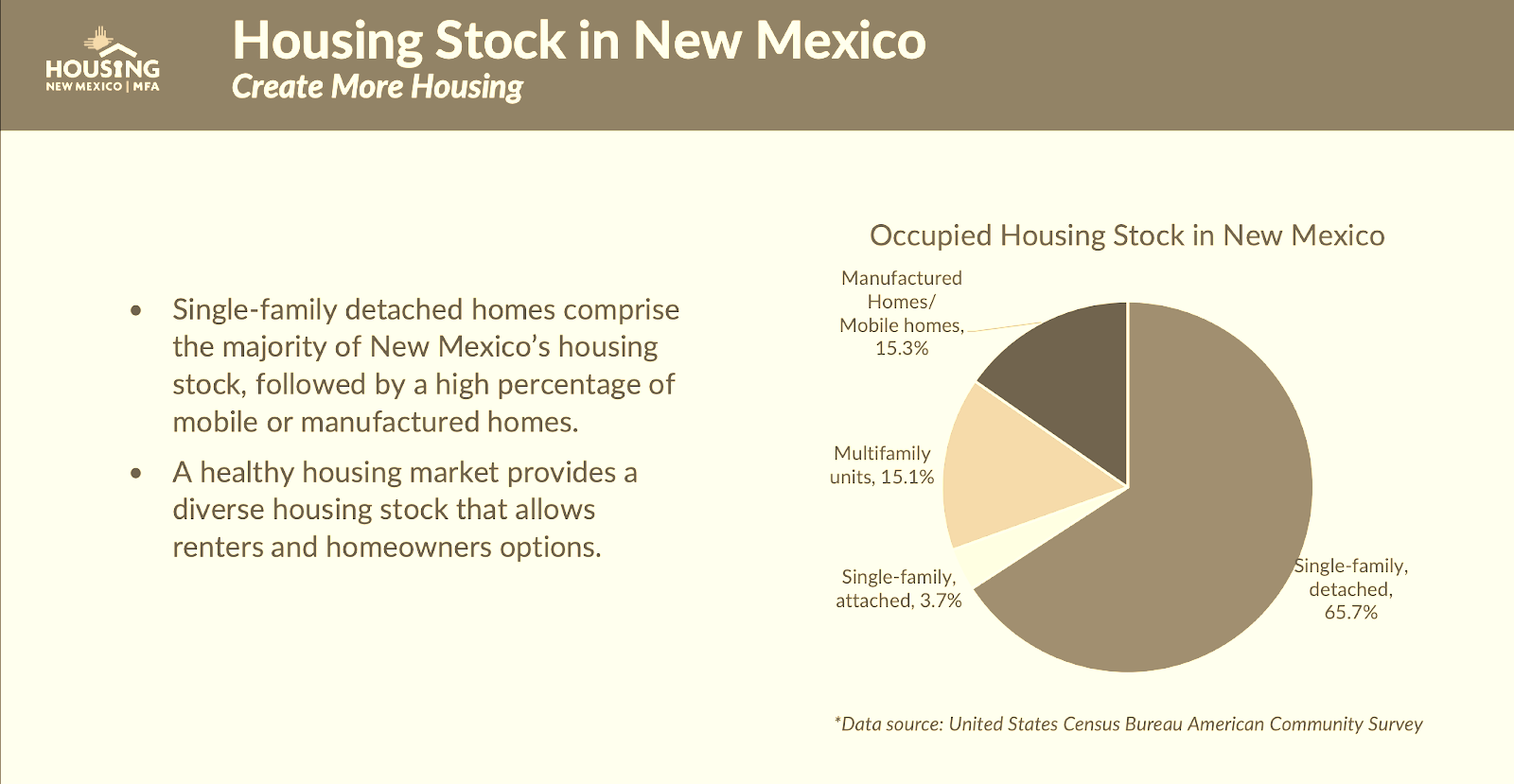
New Mexico’s housing stock is poorly matched to its actual population. According to data from the New Mexico Mortgage Finance Authority, 67% of New Mexico households consist of only one or two people, but most of our housing stock is detached single-family homes built for larger families (see image above). The people who need something different—a casita, a duplex unit, a small apartment near where they work—aren’t served by existing housing stock.
Those people did show up in force at the City Council meeting, however. They were fighting for the possibility of a home they could afford. They outnumbered the opponents, but public comments are not a vote. Five out of four councilors chose to listen to those who own the land. With land comes power.
Our future is being priced out
Jordon McConnell, an Albuquerque resident and spokesperson for Strong Towns ABQ, noticed something about the room’s demographics. “The people speaking in favor of these amendments are overwhelmingly younger than the people speaking against them,” he said during public comment. “Most of [the opponents] already own a home. That’s not a coincidence. It’s the generation that’s trying to stay here to build a life in Albuquerque, asking all of you to make just the smallest amount of room for us.”
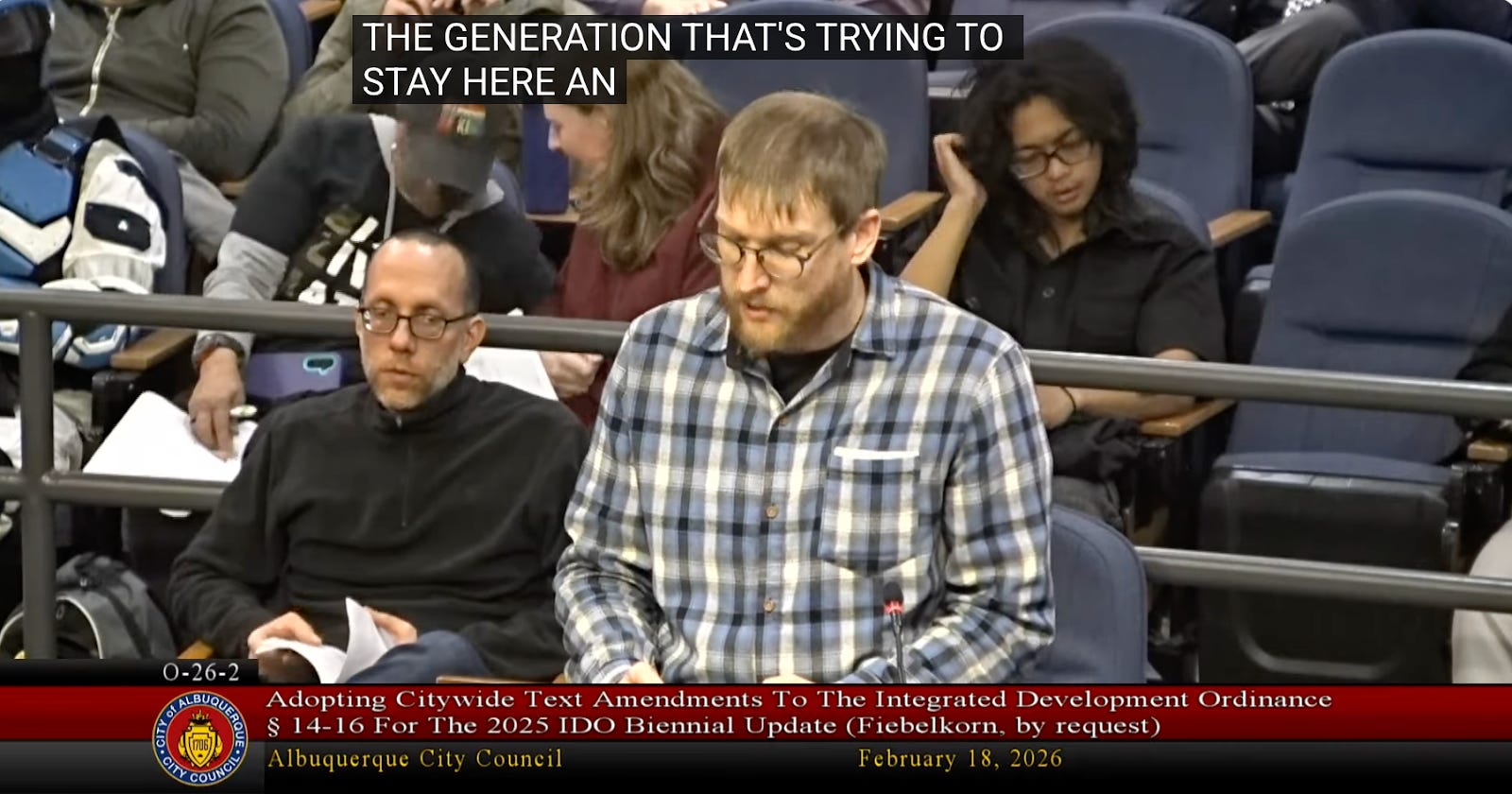
But allowing “the smallest amount of room” for the next generation was not something a slim majority of these elected officials were interested in offering. They have ears for only one type of public commenter.
“We ask that you stop the discrimination [against established homeowners] and protect and preserve our historic neighborhoods,” said resident Loretta Naranjo Lopez during public comment. “Work with the property owners and your constituents so that their input is heard and implemented.” Other property owners echoed her views.
It is completely rational for those lucky enough to own property in established neighborhoods to keep housing scarce. More supply means softer prices, and softer prices are bad news for people who’ve treated their homes as their primary financial asset. That’s the narrow, immediate interest. There’s also a completely understandable emotional investment in seeing the neighborhood you bought into remain “frozen in amber,” as one commenter put it. If you love your neighborhood, why would you want it to change?
For emotional and financial reasons, therefore, homeowners object to change. They object to new housing. And because they have more power than young renters (who often don’t have time to show up because they’re working two jobs to cover their skyrocketing rent), the homeowners get their way.
Duplexophobia
The people who need housing, who grew up here and want to stay, who are being slowly priced out of the city they love—a lot of them aren’t in the room when the votes happen. In some cases, they’re not even in the city anymore, because the housing that might have allowed them to stay was never built. You can’t vote on a city that has priced you out.
But as this meeting showed, even when young people and renters organize like crazy and outnumber the homeowners, they still can’t win. The power deck is simply stacked against them.
Fiebelkorn, who has seen this dynamic play out in committee rooms at the Legislature and now in her own council chamber, voiced her frustration: “One commenter earlier today made the statement that [single-family residential zoning] was created for a purpose,” she said Wednesday. “And I want to say, ‘Yeah, it really was. It was created for the purpose of keeping those people out of your neighborhood.’ There is no other reason to think that you would not want a duplex next door to you.”
Strip away the procedural language, and what the Municipal League spent this session defending is that arrangement—one where a city council can reject its own planning staff’s recommendations without consequence or accountability, where the question of who gets to live somewhere is answered entirely by the people already there, on behalf of no one else.
Scarcity doesn’t fix itself
Homebuilder Miles Conway, speaking to the Santa Fe New Mexican the day after the session ended, said he remained hopeful. “We’ll be back next year,” he told reporter Mike Easterling. “And, hopefully by then, city councils around the state will have taken a look at this and said, ‘We’ve got to do our part.’”
Maybe. But as Albuquerque’s council showed us on Wednesday night, waiting for the people who benefit from scarcity to end it voluntarily isn’t a housing strategy. If we keep merely hoping cities will simply choose to do better on their own, we will get another year of nothing—and another year after that, until New Mexico is empty of its future.

Sad to hear this, bummed for you (and all the tenants, young people, others affected) to suffer through through such shortsighted decisionmaking. As always, I appreciate your framing of one-size-fits-all zoning perpetuated by irresponsible local control
Only only part of this piece I’m not sure about:
“It is completely rational for those lucky enough to own property in established neighborhoods to keep housing scarce. More supply means softer prices, and softer prices are bad news for people who’ve treated their homes as their primary financial asset.”
I don’t think the fear comes from a rational financial analysis at all. Land prices could rise from increasing allowable housing density. And *land prices* definitely rise from thriving mixed-use neighborhoods with growing demand—even if corresponding housing supply increases moderate the *per unit price* of the homes there. Land owners could be reaping giant windfalls from growth
In my experience “Duplex-phobia” as you write, or Yoni Applebaum’s “tenanent-phobia” go further toward explaining why powerful anti-housing interests put such pressure on local govs. Status quo bias and fear are powerful forces. Fortunately, storytelling and positive social values can sway voters too. Grateful for the work and so many others, you will succeed in future council meetings and future legislative sessions!
Just wanted to add, I was keeping tally of the comments at that city council meeting. In a letter to the editor I submitted to the ABQ journal, I highlighted that according to my count at least the same number of people commenting pro-reform (~14) were homeowners compared to the ~14 people in total who commented in opposition. So the coalition for zoning reform is broad and includes homeowners like Councilor Telles and my family who would benefit from adapting our property to meet the evolving needs of our families.
The more we can make it clear that this isn't homeowners vs everyone else, I hope the more we can convince councilors that it's a loud minority in opposition.