
I recently finished Life After Cars: Freeing Ourselves from the Tyranny of the Automobile, a fantastic newish book from the same people (Sarah Goodyear, Doug Gordon, and Aaron Naparstek) who’ve done the War on Cars podcast. As with Yoni Appelbaum’s Stuck, I feel this book deserves more than a single review: It’s so timely, with so much to say about why our communities are struggling, that I’m covering it in four pieces, each one taking on a multi-chapter section. This is the first, covering chapters 1-3.
On September 13, 1899, a real estate agent named Henry Bliss stepped off a streetcar on West 74th Street in Manhattan and was run over by a motorized taxi. He died the next morning—the first recorded pedestrian victim of a car in American history.
Bliss wasn’t drunk or dazed; he was simply one of the last pedestrians from the Age of Pedestrians. We’re in a new age now: the Age of Cars. How do we like it? Is it working for us? Do we want to keep it? Can we even step back from it enough to ask that question, or is car-centricity the water we’re swimming in—so ubiquitous we can’t even see it?
Life After Cars is an attempt to help us see that water. Much of the book is an account of how cars came to dominate our landscape, remake our cities, harm our kids, kill our wild lands—and what it would take to undo the damage.
The first three chapters, in summary: car dominance was deliberately constructed (Chapter 1); resistance to alternatives follows a reliable script (Chapter 2); and children are paying for all of it with their safety and their freedom (Chapter 3).
The arranged marriage
Before Henry Ford’s assembly line put cars within reach of the middle class, streets were public spaces—contested, chaotic, and shared by pedestrians, vendors, streetcars, horses, and children at play. Community, commerce, and life happened in the street. Cars turned all that into asphalt. The authors draw heavily on historian Peter Norton’s research. In Norton’s framing, the car didn’t simply show up and win. There was a fight.


The Cincinnati battle of 1923 is one example. Citizens gathered 42,000 petition signatures demanding a mechanical speed limiter (also known as “speed governors”) on all cars, limiting them to 25 miles per hour. “Which shall it be?” asked a Cincinnati Post ad: “A Limit of 25 Miles Per Hour and SAFETY or No Limit, and the Lurking Danger of DEATH!” By the time of the November vote, the Cincinnati Automobile Dealers Association had mobilized every car owner in the city against the measure, which was soundly defeated.
What we lost: mechanical limiters that control how fast cars can go. Think about how nice this would be every time you have some jerk in a silver minivan crawling up your tailpipe and then passing you on a double yellow while narrowly avoiding a head-on collision with oncoming traffic. (This just happened to me, in case it sounds very specific.) We already have GPS-based intelligent speed assistance—it’s used to govern shared e-scooters and the cars of some serial speed offenders. It might be standard on every vehicle today if the Cincinnati effort had succeeded. Instead, a century later, our federal government’s primary response to speeding deaths is a campaign called “speeding catches up with you,” built around the idea of “social norming.”
The National Highway Traffic Safety Administration, which has the authority to mandate speed governors that could save lives, went with a slogan instead.
The story that Americans fell in love with cars and freely chose them over all other modes of getting around is, this chapter shows, largely a myth. Cars were a technology people were suspicious of, and car manufacturers had to work hard to arrange a marriage many never wanted.
It’s your fault
Arranged marriages tend to come with systems that make leaving hard. We’re locked into car dependence by design, yet our government at every level insists the safety problems this creates are the result of individual moral failures. “If this isn’t working for you,” the message goes, “You’re just not trying hard enough. The cars you’re married to aren’t the problem: you are.”
And we’re so carbrained that we believe it. “I’m sorry,” we whisper as we pick ourselves up off the pavement, bruised and shaky. “I’ll do better next time.”
I notice this tendency to self-blame in Los Alamos when, after every fatal crash, the community conversation keeps turning to “we need a culture change”: people should slow down, people should be more careful, people should just be better people.
The main road that feeds to my neighborhood is posted at 35 mph and designed to feel comfortable at 50 mph. Right at a curve, there’s a spot where a neighborhood street lets out onto this road. Homes sit on one side and a sidewalk on the other—right at this no-sightline section. Pedestrians cross here because that’s how you get to the sidewalk. The crosswalk is about a quarter-mile away. There is no crosswalk where people naturally want to cross because, duh, you can’t put a crosswalk where there’s no sightline. Everyone just tolerates this situation and hopes for the best.
If you’re thinking, “someone should fix that,” think about the incentives in play. I see this one old guy crossing almost daily, hobble-sprinting while holding his dog. If he gets hit by a car and dies, government officials will feel genuinely sad about that, but they won’t be held responsible for it.1 They can justifiably say, “we put the crosswalk in the correct place; that man broke the law.” You might reasonably respond, “OK, so could the County build an overpass to serve these residents?” But remember to think like a lawyer: Infrastructure has to be maintained. Infrastructure creates liability. Someone might twist an ankle on that overpass and sue.
To recap: dead pedestrians are not (usually) a liability. Twisted ankles are. Very good people get sucked into this system and respond accordingly, because that’s how systems work: they are amoral, and they are bigger than individuals. The incentive structure produces inaction, and inaction gets called “we just need to see some personal responsibility around here.”
Jays who walk
The old man clutching his dog is a jaywalker. Ever wonder where that term came from? It goes back to the same era as the Cincinnati fight. “Jaywalking” emerged c. 1905 to shame pedestrians off streets they had always occupied. A “jay” is an old term for a dumb country hick. Interestingly, “jaydriving” was also a term of abuse for drivers who had difficulty remembering to drive on the right-hand side. Motordom—a shorthand term coined by historian Peter Norton for the coalition of auto manufacturers, oil companies, road builders, and dealerships that effectively functioned as an industry lobby—popularized the word. As the authors of Life put it:
When the focus was shifted from murderous motorists to pesky pedestrians, crashes resulting in death became simply individual tragedies and not symptoms of larger societal concerns…If pedestrians were responsible for their own deaths and injuries, the government was off the hook.
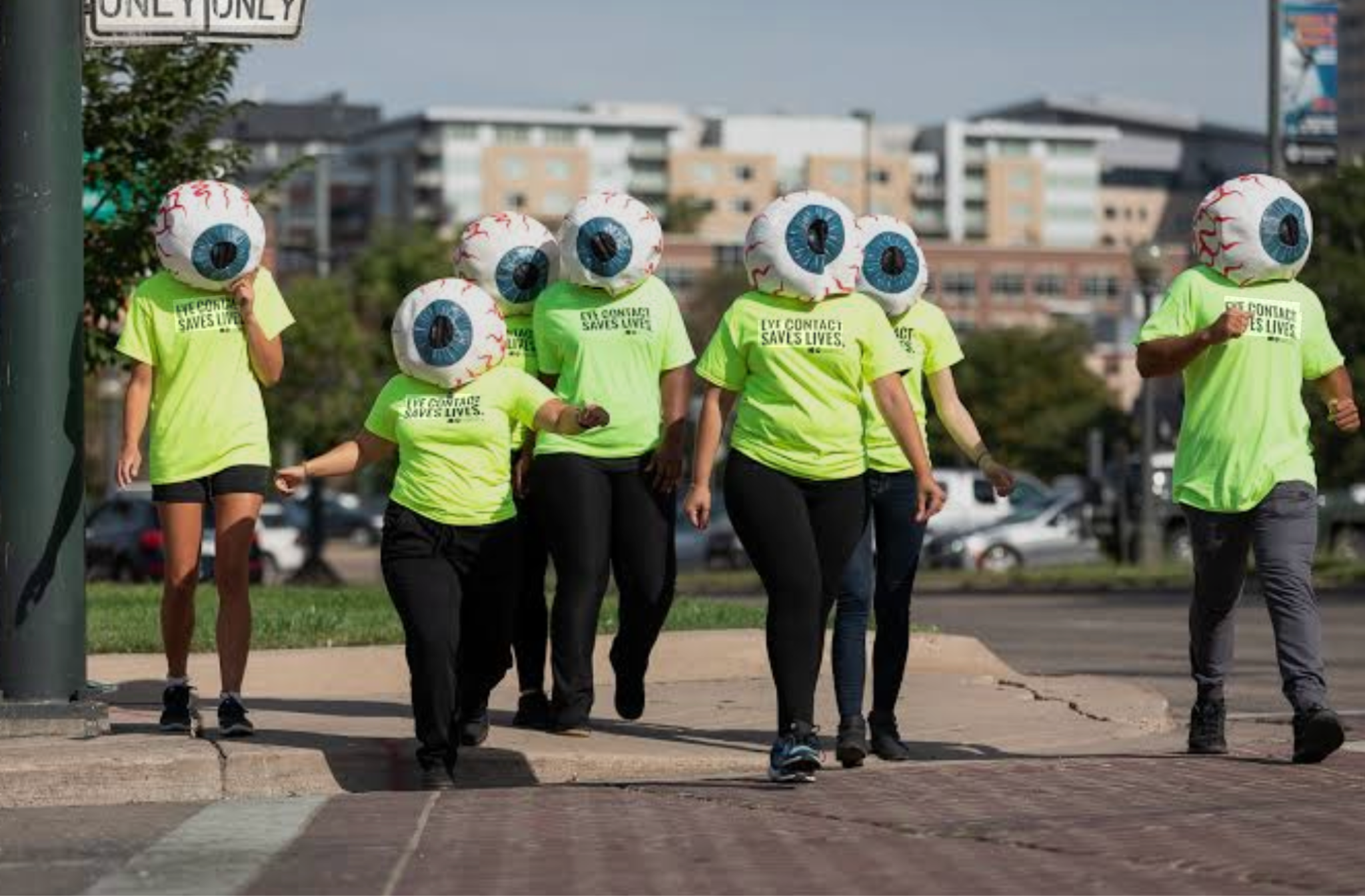
A century later, a Colorado Department of Transportation campaign sent people dressed as giant eyeballs into intersections to remind pedestrians to make eye contact with drivers before stepping into the road. I am not making this up; see the photo. The message from the government is consistent through time: When someone is killed or injured by a car, make sure you blame some individual road user and not those who designed this system.
A routine script
The second chapter introduces us to a new term: “bikelash”—the negative, outsized reaction of car culture to change. If you’ve ever been to a community meeting about a protected bike lane or a road diet and listened to drivers freaking out about sharing the road, you’ve seen the phenomenon. Naming it is useful, but the authors have also identified a script so consistent across time and geography that it functions like Mad Libs: fill in the city name and street address, and the objections practically write themselves. Here are two:
Predictable objection one: “I like bikes, but...” The authors give two prominent examples of this objection: In 2019, Whoopi Goldberg, after noting how very much she likes bikes, told then-Mayor Bill de Blasio that he had wrecked 10th Avenue by putting a bike lane there. However, a not insignificant problem with her rebuke was that there was no bike lane on 10th Avenue. In the same vein, New Yorker writer John Cassidy criticized investment in bike lanes by citing the empty bike lane he saw while driving up Brooklyn’s Fourth Avenue. As in the 10th Avenue case, though, Fourth Avenue had no bike lane. It had six car lanes and parking on both sides. Both of these anti-bike people started their objections with “I like bikes, but…” They were also just factually wrong.
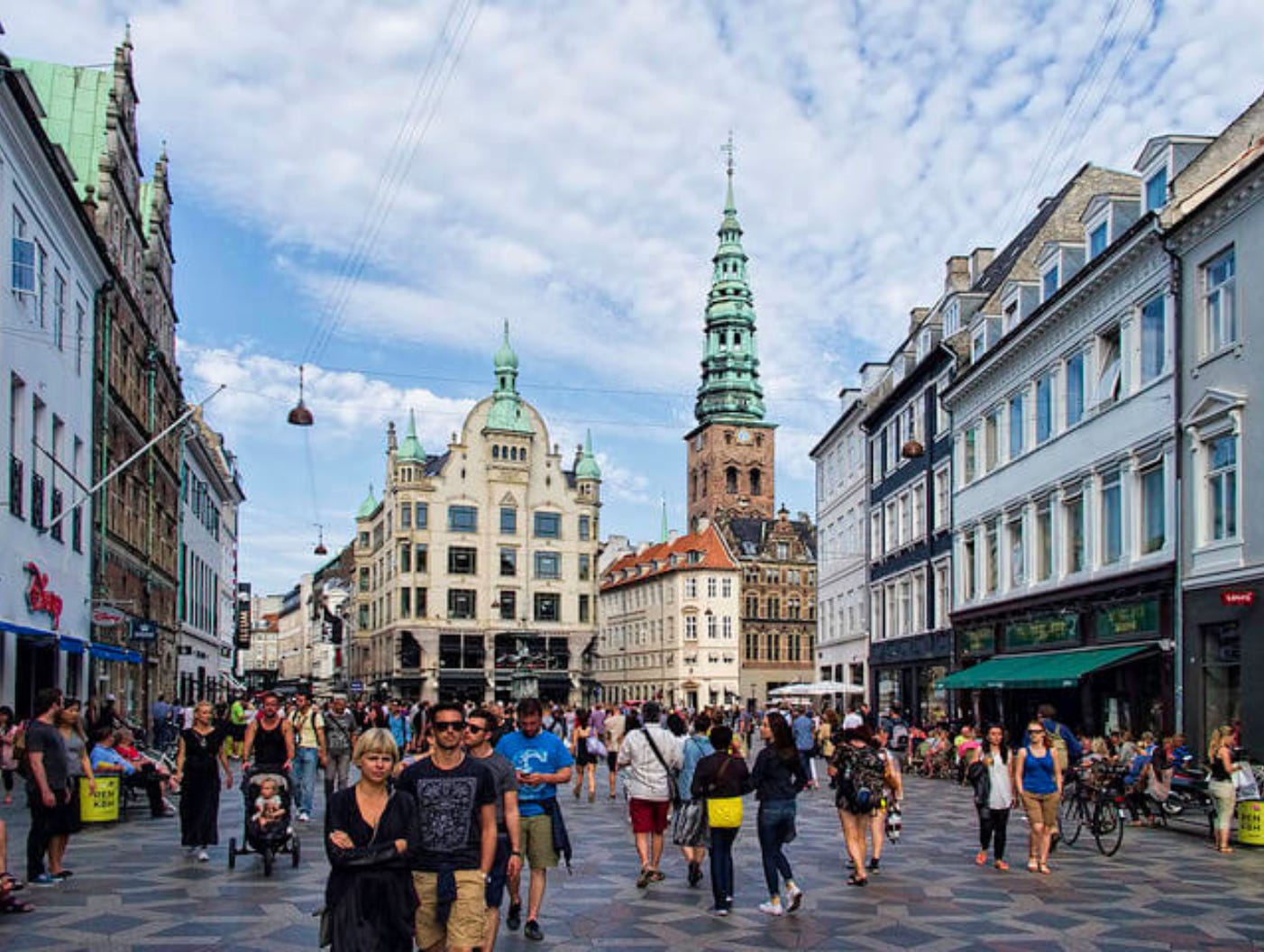
Predictable objection two: “We’ll never be Amsterdam.” The authors demolish this by noting that Amsterdam wasn’t always Amsterdam. And Copenhagen wasn’t always Copenhagen. In the 1950s, that capital city was beginning to get paved over, just like so many cities. To accommodate the car, Danish planners proposed a twelve-lane road through the city center—a plan that would have demolished historic neighborhoods and paved over the city’s lakes. That plan died, but cars kept spreading. By 1962, officials bravely decided to reverse course and pedestrianize Strøget, a main shopping street. This plan was met with fierce objections from local merchants who insisted that Copenhageners needed their cars, especially in winter. “We’re not Italians, we’re Danes,” the shopkeepers said.
The city ran pedestrianization as a two-year experiment. Pedestrian volumes increased 35% in the first year alone. Strøget was permanently pedestrianized in 1964, and “stopping and staying” activity—browsing, eating, lingering—eventually increased by 400%. Copenhagen’s shopkeepers today aren’t complaining. (It’s a shame that business communities around the world, to this day, often fight pedestrianization when it’s so good for commerce.)
The “we’re too different for that” argument is always the same (ironically) and consistently wrong. I wrote here about the general phenomenon of “special snowflake syndrome.”
Other good things happen when infrastructure changes. The authors tell the story of Prospect Park West: Before a protected bike lane was installed on the Brooklyn street, about half of all cyclists rode on the sidewalk—a habit was illegal, dangerous, and very predictable given that the alternative was mixing with fast-moving vehicles. After the lane went in, sidewalk cycling dropped from 50% to 3%. Jon Orcutt, former NYC DOT Policy Director, said: “If your policy changes infrastructure, it will change culture.” Sometimes culture changes gradually, but in this case, it was immediate.
Sadly, we don’t usually hear about these successes. Media coverage and the polling data are often out of sync because the media likes to hype controversy and is complicit in the “all change is bad” narrative. Support for safe road infrastructure is much higher than most newspaper coverage would have you believe: at the height of New York City’s bike lane fights, a New York Times poll showed 64% approval for bike lanes and 73% approval for the Citi Bike bikeshare program. Mayor Bloomberg’s approval rating at the time was 49%.
The loudest voices at community meetings are often against bike infrastructure (which makes everyone safer), but it is important to remember that the loudest voices do not usually form the majority of any community. (Dear fellow journalists: please get this fact into your heads!)
Children in glass coffins
For decades, motor vehicle crashes were the leading cause of death for children and adolescents in the United States. Guns only took the top spot in 2020.
Guns and cars, I thought, while reading chapter 3. Cars and guns.
Two American obsessions—both masculine-coded, and both fiercely resistant to sensible safety regulation—now trade the top position in the ranking of things most likely to kill a child. In 2022, an estimated 429 American children were injured in traffic crashes every single day. But the damage goes beyond children directly hurt by cars. Growing up in neighborhoods designed around fast-moving traffic changes how any child experiences their world. The built environment has narrowed the boundaries of childhood, teaching kids where not to go, what not to do, and which parts of their own neighborhoods are too scary to explore.
Bruce Appleyard, an urban designer and professor of city planning at San Diego State University, has figured out a way to study this. Working with groups of nine- and ten-year-olds from two communities—one with light traffic, one with heavy—he asked them to draw maps of their neighborhoods, including places they loved and places they feared. The children in the high-traffic community drew skeletal, fear-marked maps with little detail. Fewer trees. Fewer destinations. Fewer places to play. Many seemed barely to know their own neighborhoods. By contrast, the children in the low-traffic community drew rich, detailed maps and identified 43% more places where they played. When the high-traffic community later improved some of its pedestrian infrastructure, the kids’ maps became more detailed, and expressions of fear declined.
Even now, writing about it, I feel emotional all over again about the shrunken, sad lives our poor children lead these days, stuck as they are in auto-centric suburbs, transported here and there while staring at little screens in the backseat of the family SUV.

The book mentions guns in passing, but I thought about guns a lot due to my years spent as a gun-safety advocate with Moms Demand Action for Gun Sense in America. Freedom-loving men, with their cars and guns, love to talk about how we’re overprotecting children. But what has really happened is that, because of guns and cars, children have lost access to the public realm. We are too afraid to let them out of safety cages. They are tucked away, placed in glass coffins like Snow White, to be preserved until adulthood. As if that’s not going to harm them. To me, this is a freedom issue. This is a liberty issue. Because these children have no freedom to explore, no liberty to roam, and it’s ruining their lives.
The issue of guns killing kids remains politically insoluble, but the authors end with a hopeful example of reclaiming a little bit of public space for children—bike buses are sprouting up in cities, allowing children to ride to school in groups and reclaim streets that were never built for them. Watch this bike bus in Portland, and you will feel better about the world:

 Tiktok failed to load.
Enable 3rd party cookies or use another browser
It’s a great story to end on. But as the authors say, an organized bike bus only makes news because it’s so weird to see children getting to school any other way than being personally ferried in private vehicles.
This system was built piece by piece over the last century—sometimes accidentally, often deliberately, and at enormous human cost. The people who have paid the highest price for it—children, pedestrians, and entire communities bulldozed to make way for the car—are not asked their opinion or permission.
Why are advocates for safer streets expected to prove every benefit while defenders of the current system are never asked to explain its costs? We’ve spent decades demanding that advocates for safer streets justify every proposed change while accepting more than 40,000 traffic deaths a year as the normal cost of modern life.
The next three chapters lay out what other costs we’ve been paying, in categories we’re even less accustomed to counting: the ecological cost, the public health cost, and the cost to physical and emotional human connection. I turn to these next.
I’m pretty hard on the government, but car manufacturers and smartphone manufacturers also play a huge part in the road/death system—and they aren’t held responsible for the carnage, either. Giant trucks, thick sight-blocking A-pillars, addictive technology: it all adds up to 40,000 deaths annually. But the private sector has zero incentive to fix these problems, so we’re back to government: it must step in.
Reading this mere minutes after hearing the news that eminent American History scholar Gordon S. Wood was killed at the age of 92 being hit by a car in a parking lot feels really bleak. Another long, full life ended by a car.
Terrific reflection on the early chapters of a phenomenal book! Economists have largely fooled us in presenting a limited dichotomy of “revealed” and “stated” “preferences.” Applied to cars and driving, we are often made to believe that the majority prefer cars and automobility given their observed driving behaviors (revealed preference) or their expressed desires to continue driving in the future (stated preference). Another, more realistic way to look at driving in much of the US is to see it as a means of adapting to constraints, a “constrained adaption” to a world in which all non-driving options have been rendered impossible, self-evidently dangerous, or entirely inconvenient and impractical.